In a nutshell
- 🍋 Lemon peel contains limonene, citral, and linalool whose volatile oils repel pests and mask plant cues on contact.
- 🐜 Citrus aromas disrupt ant pheromone trails, causing scouts to lose the path and reducing worker traffic to aphid colonies.
- 🍯 Mild acidity helps dissolve sticky honeydew, removing the sugary signal that attracts and sustains ant–aphid partnerships.
- 🛠️ Application: lightly rub zest on leaves and stems in cool hours, patch test tender foliage, and reapply every 24–48 hours or after rain.
- 🧩 For best results, use within integrated pest management: rinse infestations, prune heavily infested growth, deploy barriers, and support beneficial insects.
Gardeners love a hack that costs nothing and works fast. Rubbing fresh lemon peel on leaves belongs in that category, a simple gesture that chases away ants and aphids without chemicals from a bottle. The secret isn’t magic; it’s chemistry meeting insect behavior in real time. Citrus rinds are loaded with aromatic volatile oils and acids that change the scent landscape on a plant. Those odors scramble ant pheromone trails and make leaves less appealing to sap-sucking pests. It’s a kitchen-scrap solution with surprising punch. Done correctly, it keeps the tiny ranchers and their livestock from returning—and gives your plant a breather to recover.
The Chemistry Inside Lemon Peel
Inside a lemon’s zest lives a cocktail of bioactive compounds that insects don’t love. Chief among them is limonene, the terpene that makes citrus smell like summer. It’s joined by citral and linalool, plus organic acids and sticky resins. These volatile oils evaporate readily, flooding the boundary layer around a leaf with strong, unfamiliar scents. That cloud is precisely what ants and aphids read as “hostile terrain.” Some components act as repellents, others as mild solvents that smudge chemical cues. Together, they create a short-lived, plant-safe barrier that shifts how insects navigate and feed.
| Compound | Primary Action | Persistence (Outdoors) |
|---|---|---|
| Limonene | Masks trails; mild neurotoxic effects on some insects | Hours to 1–2 days in dry conditions |
| Citral | Strong odor cue; deters landing and feeding | Short, often less than 24 hours |
| Linalool | Repellent; contact irritant at higher levels | About a day; faster loss in sun |
| Organic acids | Slight surface pH shift; cleans honeydew residue | Very short; washed off by dew or rain |
There’s a second, quieter effect. Lemon’s mild acidity helps dissolve sticky honeydew left by aphids, the sugary film that attracts and rewards ants. When that buffet disappears, so does the incentive for ants to farm and defend aphid colonies. Clean leaf surfaces plus overpowering citrus volatiles equal fewer insects lingering and far fewer returning.
How Citrus Scents Disrupt Ants and Aphids
Ants run on chemistry. They lay and follow pheromone highways to food. Lemon peel turns those highways into detours. The oils smear and mask trail compounds, and the strong top notes override an ant’s ability to lock onto the right signal. The result is confusion: scouts lose the path, and the flow of workers to aphids slows to a trickle. Species differ, but the disruption is often immediate. You’ll see wandering, hesitating, retreating—micro-chaos on the stem.
Aphids receive a different message. The citrus film makes leaves slicker and less appetizing, and it interferes with their alarm chemistry, especially signals related to E-beta-farnesene. Some simply drop off. Others probe less and move on, saving your plant from additional sap loss and virus transmission. And then there’s the broken partnership: no ants shepherding and protecting aphids means fewer pests survive to re-colonize the same leaf. Without bodyguards, predators—lady beetles, lacewings, hoverfly larvae—clean up what’s left, tipping the balance toward a natural reset.
There’s also a visual-mechanical twist. Citrus oils can loosen stubborn residues, reducing the shine and smell of honeydew that signals “food here.” In effect, you’re erasing the billboard as well as the road leading to it.
Practical Steps, Safety, and Frequency
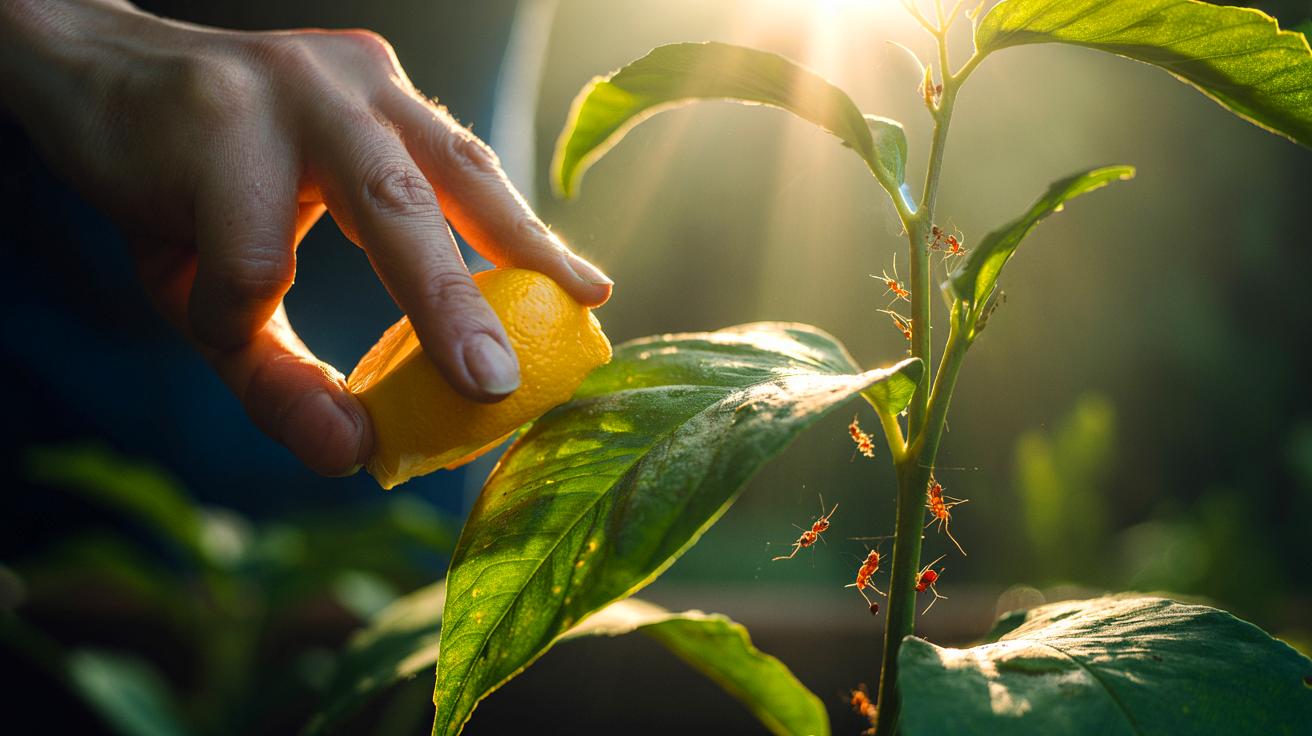
Use a fresh lemon. Slice off a piece of peel and rub the zest side lightly over affected leaves and stems. A thin film is enough; you’re painting scents, not varnishing the plant. Hit the underside of leaves where aphids cluster, then swipe along ant travel lines to scramble their map. Work in the early evening or on an overcast day to minimize stress. In dry weather, repeat every 24–48 hours until activity drops. Reapply after rain or heavy watering splashes that rinse the oils away.
Be gentle on tender foliage. Citrus oils are potent, and heavy applications can irritate leaf tissue. Do a small patch test on one leaf and wait a day. Avoid delicate, hairy leaves (African violets), glaucous coatings (some succulents), and open blossoms. If you see bronzing or scorch, stop and switch to diluted approaches: a few drops of lemon essential oil in water with a touch of mild soap, shaken and lightly misted. Keep sprays off beneficial insects when possible and never drench soil—this is a surface deterrent, not a drench.
Timing matters. Morning dew shortens persistence. Hot sun speeds evaporation and can raise phototoxicity risk. Aim for cool, dry windows. Combine the treatment with a quick rinse to remove heavy aphid loads first; the peel then serves as your lock on the freshly cleaned door.
Evidence, Limitations, and When to Try Something Else
Laboratory and field notes point the same direction. Studies on limonene and linalool show repellent and contact effects for common species, including the invasive Argentine ant, while gardeners repeatedly report rapid trail disruption after citrus applications. It tracks with what entomologists know: ants’ reliance on chemical navigation makes them vulnerable to scent noise, and aphids respond quickly to altered surface chemistry.
But this is a management nudge, not a silver bullet. It won’t eliminate an ant colony or cure a severe aphid outbreak on its own. Wind, heat, and UV break down citrus volatiles quickly. Heavy infestations, hidden colonies in walls or soil, and steady reinvasion from neighboring plants can overwhelm the effect. If you’re seeing curls of new growth packed with aphids day after day, escalate.
Think in terms of integrated pest management. Blast colonies with water, prune the worst clusters, use insecticidal soap where permitted, set sticky barriers on trunks to intercept ants, and invite allies with nectar-rich flowers to boost lady beetles and lacewings. The lemon-peel pass then becomes your maintenance tool—a short-lived, renewable deterrent that buys time for the rest of your strategy to work.
This humble, fragrant trick taps into the code insects use to move and feed, rewriting it just long enough to tip the fight in your plant’s favor. It’s cheap. It’s fast. And when paired with basic cleanup and smart timing, it’s surprisingly effective at keeping ants and aphids from circling back. Think of lemon peel as a reset button for a stressed leaf’s scent signature. Have you tried citrus on your own plants—did you notice different responses from ants versus aphids, and which peel (lemon, lime, orange) gave you the best results?
Did you like it?4.5/5 (28)