In a nutshell
- 🌡️ Calcium carbonate in eggshells buffers compost pH, releases Ca2+, and frees bound phosphorus from Fe/Al, accelerating nutrient availability.
- 🌬️ Crushed shells add grit that improves aeration and water flow, while calcium “bridges” raise cation exchange capacity (CEC) so nutrients stay accessible near roots.
- 🧫 Shell surfaces host active biofilms; Actinomycetes, Bacillus, and mycorrhizae solubilize nutrients and build faster delivery pathways to root hairs.
- 🧪 Prep matters: dry and grind to a fine powder for maximum surface area; an optional vinegar pre-soak forms calcium acetate for quick plant uptake.
- 🌱 Apply contextually—sandy soils gain CEC, clays gain structure; avoid excess in alkaline beds—yielding faster, steadier nutrient uptake and fewer calcium-related disorders.
In the quiet churn of a backyard bin, crushed eggshells do more than disappear—they rewire the chemistry that decides whether plants feast or starve. Gardeners swear by them, but the payoff isn’t folklore. It’s chemistry, biology, and time, working in sync. When finely ground shells meet moist organic matter, they release calcium carbonate and trace minerals in ways that push compost toward the sweet spot where roots drink faster. By tuning pH, stabilizing structure, and fueling microbes, eggshells help nutrients move from compost to root hairs at speed. The result is visible: sturdier stems, confident leaves, and fewer puzzling deficiencies.
How Eggshells Change Compost Chemistry
Eggshells are built of more than kitchen waste; they’re roughly 95% calcium carbonate (CaCO3), a natural buffer that tempers swings in acidity as compost heats and cools. Active piles exhale CO2; moisture turns that gas into carbonic acid, which nibbles at the shells and releases Ca2+ ions. That trickle matters. In acidic compost and soils, aluminum and iron bind phosphate into forms roots can’t access. Calcium changes the equation, loosening those bonds and nudging phosphorus back into solution where plants can grab it. The outcome isn’t instant, but in a living pile, it’s fast enough to matter for a growing season.
There’s also a structural dividend. As shells fragment, they add grit that keeps compost fluffy, improving aeration and water movement. Better airflow lifts microbial metabolism; water films thin to the right thickness for ion diffusion. The compost’s cation exchange capacity (CEC) improves as calcium “bridges” between humic molecules and clay, creating more charged sites where nutrients cling until roots request them. When CEC rises, nutrients linger near roots instead of washing away, and delivery accelerates under demand. Small change. Big effect.
From Calcium Carbonate to Plant Fuel: The Science
Plants absorb nutrients through finely tuned transport systems. Calcium doesn’t travel like nitrate or potassium; it moves with transpiration and locks into cell walls, membranes, and signaling pathways that orchestrate uptake of other ions. Steady Ca2+ around root tips strengthens new cell walls, preventing “leaky” membranes and improving the gradients that drive uptake. That means faster flow of nitrate (NO3-), potassium (K+), and phosphate (H2PO4-) when a plant hits a growth spurt. In compost, eggshell-derived calcium also neutralizes organic acids that would otherwise slow nutrient transport across cell membranes.
There’s a kinetic side, too. Finely crushed shells present massive surface area, and dissolution rate scales with that area. In a warm, microbially active pile generating weak acids, powdered shells release calcium within weeks rather than years. Contrast that with whole halves, which can linger intact across seasons. Pair this with compost’s surge of organic chelates that keep micronutrients soluble, and you get a substrate where ions stay mobile. In short: finer particles, faster chemistry, quicker plant uptake.
Microbial Partnerships and Faster Nutrient Highways
Compost is a city of microbes, and eggshells furnish new neighborhoods. Their rough surfaces host bacterial biofilms and fungal hyphae that build the conduits delivering nutrition to roots. Actinomycetes and Bacillus species thrive on the shell’s carbonate edge, releasing enzymes and organic acids that liberate phosphate and trace elements from stubborn bonds. Those micro-scale factories turn locked nutrients into ions that glide across thin water films toward root hairs and mycorrhizal tips. As that traffic intensifies, plants respond with more root branches and fine hairs, expanding their absorption front.
Mycorrhizal fungi complete the circuit. Given a calcium-tuned, moderately acidic-to-neutral compost, their hyphae stretch farther, exchanging carbon for minerals at favorable rates. Calcium also helps flocculate particles, creating stable crumbs that protect fungal networks from collapse during watering. The result is faster, steadier delivery of N, P, K, and micronutrients along living threads. When structure, chemistry, and biology align, nutrients do not merely exist in compost—they arrive at roots right when plants ask for them.
Practical Steps, Particle Size, and Timing
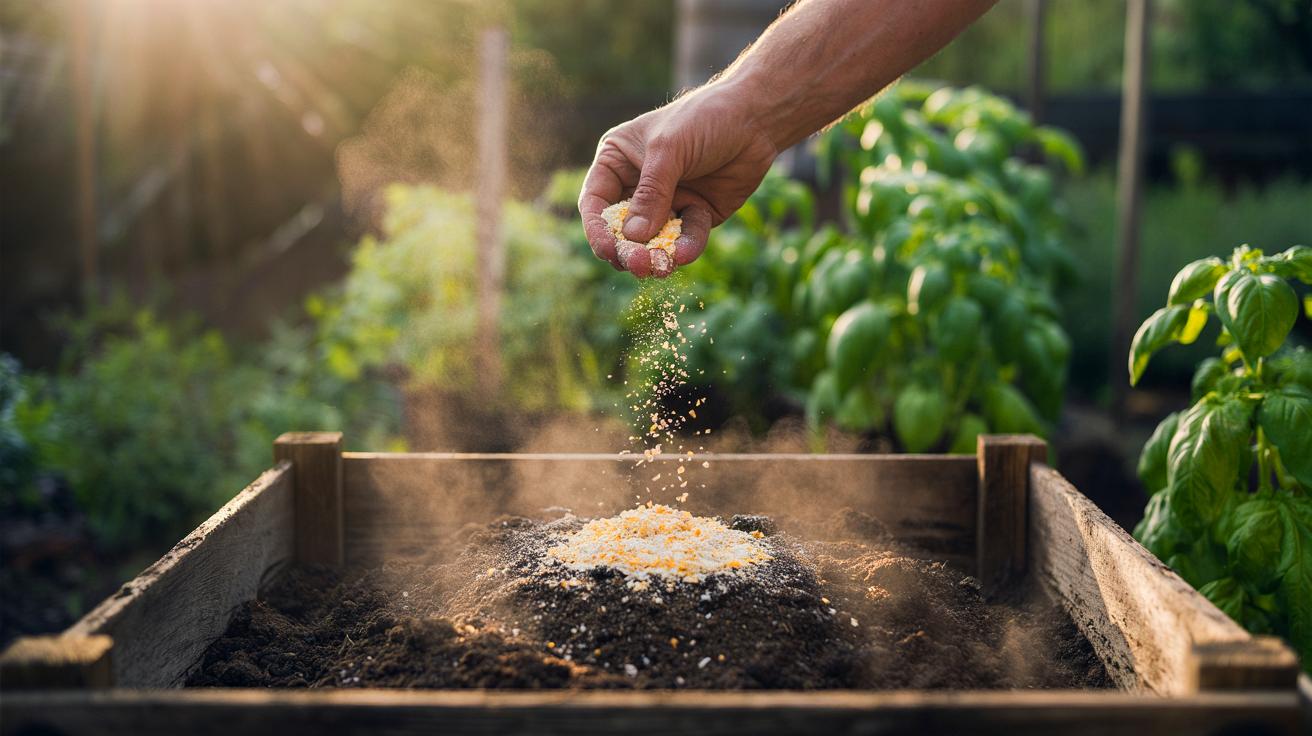
Start by drying shells thoroughly; a quick oven bake drives off moisture and reduces pathogens. Crush to powder—mortar and pestle, rolling pin, or a dedicated coffee grinder. Powder is the difference between a geological timeline and a gardening timeline. Fold the powder through your browns and greens, not in a single layer, so microbial hotspots can work on it from every angle. If your compost skews alkaline, go lighter; if it’s sour and heavy, add more. A brief vinegar pre-soak creates calcium acetate, which plants can access rapidly once diluted into the pile or a finished compost tea.
| Action | Why It Matters | Timeframe/Result |
|---|---|---|
| Dry and sterilize shells | Reduces pathogens; crushes cleanly | Immediate handling benefit |
| Grind to fine powder | Maximizes surface area; faster Ca2+ release | Weeks in hot, active compost |
| Mix evenly through pile | Contacts acids and microbes uniformly | Improved pH buffering and CEC |
| Optional vinegar pre-soak | Converts to quick-acting calcium salt | Days; rapid availability |
Think context. Sandy soils appreciate the CEC bump. Tight clays appreciate flocculation and aeration. Avoid overuse in already alkaline beds and monitor with a simple pH test. Right dose, right grind, right pile temperature—those three make shells a sprint, not a marathon.
Crushed eggshells don’t act alone; they set the stage. By smoothing pH spikes, building exchange sites, and empowering microbes, they convert finished compost into a nutrient delivery system that plants exploit quickly. The payoff is subtle at first—fewer blossom-end rot scares, perkier new leaves—then obvious during peak growth. Use them thoughtfully and you’ll notice roots finding what they need sooner, not later. What part of your compost routine could you tweak—particle size, mixing pattern, or microbial heat—to turn humble shells into your fastest nutrient lane?
Did you like it?4.6/5 (28)