In a nutshell
- 🍊 Orange peels fuel fast decay with pectin, sugars, and volatile d-limonene that quickly dissipates, favoring terpene-tolerant microbes and fungi that raise heat and speed breakdown.
- 🛠️ Prep matters: use shredded or finely chopped peel, try a freeze–thaw cycle, light air-drying, or a pourable citrus slurry paired with coffee grounds for even distribution and better aeration.
- 📏 Balance the mix: target a practical C:N of about 1 part peel, 1 part greens, 2 parts browns; manage brief pH dips, keep moisture like a wrung-out sponge, and aim for 130–150°F with a clean, earthy scent.
- 🧪 Try simple tests: compare whole vs shredded peels, brew a pre-soak “citrus tea,” inoculate with finished compost, and add biochar to adsorb oils and provide microbial housing.
- 🧩 Think food and structure: peel particles act as fuel and scaffolding, letting fungal hyphae spread; turn within 24 hours of large citrus additions for faster, steadier thermophilic peaks.
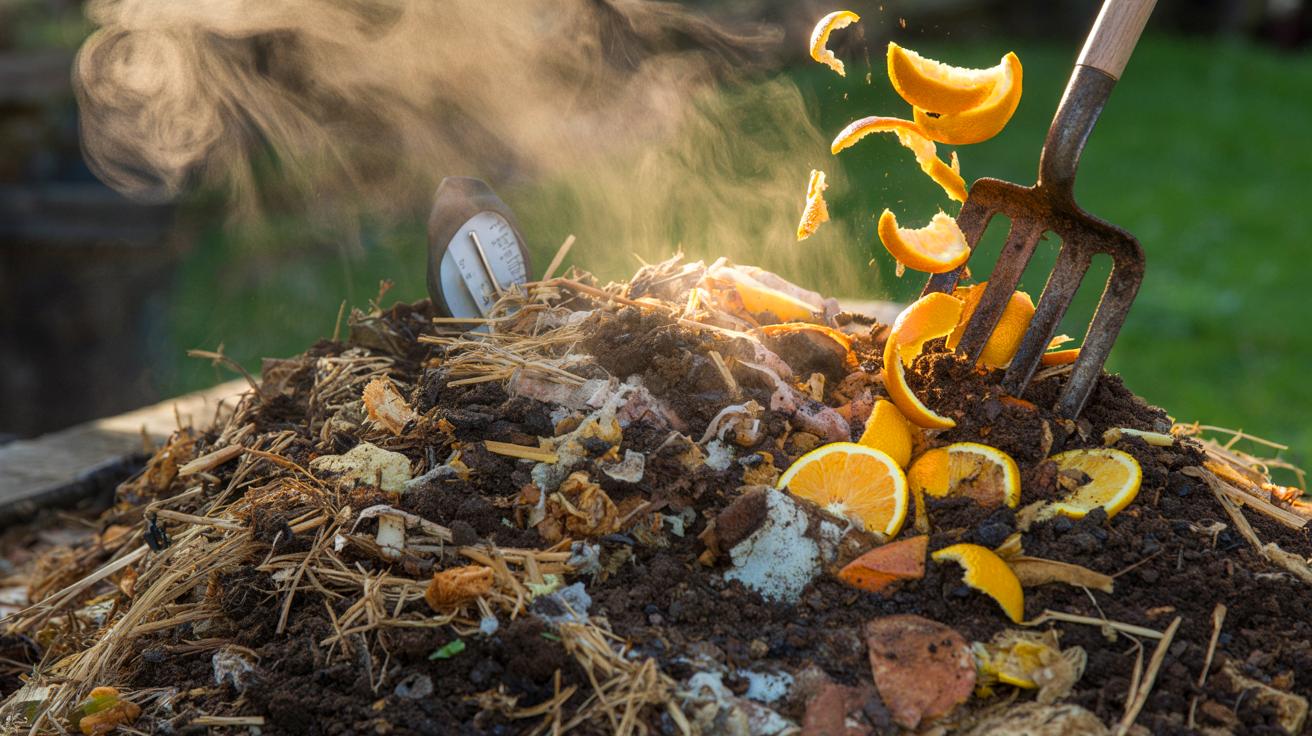
Composting has a reputation for patience. Piles warm, cool, and transform kitchen scraps on their own schedule. But there’s a surprising accelerator hiding in the fruit bowl: orange peels. Long dismissed as too acidic or antimicrobial to help, they actually hold compounds and textures that can speed the breakdown process when used intentionally. Aromatic oils volatilize, sugars and pectin feed fast-growing microbes, and shredded rind becomes a scaffold for fungi. The trick isn’t magic. It’s chemistry and technique. Handled correctly, citrus peels can nudge a sluggish heap into a lively, heat-building engine—without inviting pests or sour odors.
The Science Inside Orange Peels That Supercharges Decay
Orange peels are biochemical powerhouses. They’re loaded with pectin, simple sugars, and micronutrients that fuel bacterial booms, especially early in a compost cycle. They also contain d-limonene, an aromatic terpene often called out for its antimicrobial punch. Here’s the twist: limonene flashes off quickly as piles warm, while specialized microbes evolve to metabolize terpenes, producing enzymes that help unlock tougher plant polymers. What begins as a mild inhibitor can become a selective pressure that favors highly active decomposers, setting the stage for faster structural breakdown.
Citrus also brings a short-lived pH dip via citric acid. That temporary acidification helps solubilize certain minerals and can aid early-stage hydrolysis of hemicellulose. Fungi love the rind’s porous matrix; their hyphae thread through shredded peel, creating highways across the pile. As microbial respiration increases, heat rises. Heat accelerates enzyme activity. A positive feedback loop emerges.
Think of peel particles as both food and infrastructure. Sugars spark growth. Fibrous albedo provides aerated surface area. And once thermophilic microbes take over, the compost’s “engine” runs hotter, longer, and more evenly.
Preparing Peels for Maximum Surface Area and Microbial Access
Size matters. Small pieces, well mixed, decompose faster than whole rinds. Use a knife, food processor, or garden shears to create shredded or finely chopped peel. More edges mean more microbial docking sites. If you’re dealing with thick rinds, try a quick freeze–thaw cycle; ice crystals rupture cell walls, releasing sugars and softening fibers. Another hack: air-dry peels for a day, then crumble. Drying reduces limonene’s persistence and makes particles feather-light, improving aeration when blended with “browns.”
Consider a citrus slurry. Blitz peels with water into a pulpy pour, then drizzle into the pile as you turn it. The liquid spreads sugars evenly, reducing pockets that might turn anaerobic. For a nitrogen boost, pair slurry with coffee grounds or fresh grass clippings. Aim for moist-but-not-soggy: like a wrung-out sponge. If your bin tends to compact, fold in a handful of coarse browns—shredded cardboard, straw—to counter wetness from the slurry.
Keep inputs steady. Add citrus in modest, frequent doses rather than a bulk dump. The result is a lively, sustained burn instead of a smothered flare.
Balancing the Pile: Ratios, pH, and Odors When Adding Citrus
Compost thrives on balance. Orange peels lean carbon-rich (roughly 35–50:1 C:N) yet carry readily digestible sugars, so pairing them with nitrogenous “greens” prevents stalls. Mix roughly one part chopped peel with one part greens and two parts browns by volume, then adjust by feel. If the pile cools, you need more greens; if it smells sour, stir in browns and re-aerate. Aim for a steady 130–150°F during the thermophilic phase and a sweet, earthy scent. That’s your dashboard.
| Factor | What Orange Peels Do | Signal to Watch | Quick Fix |
|---|---|---|---|
| C:N Ratio | Adds carbon, fast sugars | Slow heat rise | Add greens (grounds, grass) |
| pH | Briefly lowers pH | Vinegary whiff | Turn pile; add browns |
| Moisture | Can wet spots | Clumps, matting | Fluff; mix straw/cardboard |
| Pests | Oils deter some pests | Fruit flies swarming | Cover with browns; bury 6 inches |
Turn the pile within 24 hours of a large citrus addition to distribute oils and oxygen. A compost thermometer helps: stronger peel prep and better mixing typically shorten the time to peak heat by a day.
Field Notes and Small Experiments You Can Try at Home
Test it like a reporter. Build two mini piles or bin sections of equal size. In one, add whole peels. In the other, add shredded peels plus coffee grounds. Track temperatures twice daily for a week. Most home trials show the chopped-peel pile hits peak heat sooner and maintains it longer. Note odors too. A citrus-forward pile should smell bright at first, then mellow into earthy sweetness as terpenes volatilize.
Try a pre-soak citrus tea: steep chopped peels in warm water for 24 hours, then pour the liquid across a turned pile and mix the softened solids throughout. Pair with a scoop of finished compost to inoculate the heap. For bins prone to sour spots, blend in a cup of biochar when adding peels; it adsorbs oils and provides microbial housing, smoothing the rise to thermophilic temperatures. Keep notes. Small tweaks compound.
The unexpected win isn’t just faster decay—it’s more stable heat and fewer pests. That’s a quiet revolution powered by breakfast leftovers.
Orange peels don’t break compost rules; they clarify them. When chopped, balanced, and mixed, they feed a cascade of microbes that build heat, move air, and turn scraps into rich, friable humus on a tighter timeline. The fragrance fades. The enzymes stay busy. And the pile tells you, in temperature and texture, that your inputs are working smarter. So the next time you peel an orange, think like a tinkerer: What size, what mix, and what timing will push your heap from warm to roaring hot—and what results will you measure first?
Did you like it?4.5/5 (22)