In a nutshell
- 🌿 A light vinegar mist (about 0.25% acetic acid) can reset a sluggish compost overnight by reducing odors, loosening crusts, and favoring aerobic microbes.
- ⚙️ Method: pre-turn the pile, mist evenly, cap with dry browns, add airflow, and check temperature by morning; never use undiluted vinegar and avoid vinegar in worm bins.
- 🧴 Selection: choose white distilled (5%) for consistency; dilute stronger cleaning vinegar (6–8%); skip sugary or flavored vinegars that can attract pests.
- 🧪 Science: a mild pH drop converts ammonia (NH3) to ammonium (NH4+), prunes anaerobes, improves wettability, and keeps the pile within the pH 6–8 comfort zone.
- 📊 Big picture: prioritize C:N balance, structure, and aeration; use vinegar as a catalyst, then track inputs and temperature to fine-tune your system.
Compost slows down for ordinary reasons: imbalances, compaction, fickle weather. Yet a humble pantry staple can jolt it back to life before sunrise. Vinegar, rich in acetic acid, doesn’t “fix” organic waste by magic; it nudges chemistry and biology into a friendlier lane for aerobic microbes. Think of it as a reset button, not a cure-all. A light, well-aimed spray can knock back odors, loosen slimy mats, and make room for oxygen. Then the pile can do what it does best—heat, digest, transform. Used correctly, vinegar acts as a fast nudge rather than a sledgehammer. Used carelessly, it can stall progress. The difference is in the dose and the follow-through.
Why a Compost Pile Stalls—and What Vinegar Changes
When a pile turns sluggish, the usual culprits are predictable: too many “greens” and not enough “browns,” a collapsed structure that squeezes out air, or a dry crust that sheds water. Excess protein-rich inputs encourage ammonia release. Anaerobic pockets bloom. The result is familiar—strong odors, low heat, and a wet, heavy feel. Carbon-to-nitrogen balance (C:N) and aeration remain the bedrock fixes, but vinegar can provide a jump-start by addressing surface chemistry quickly.
Here’s why it works. A diluted mist of vinegar lightly acidifies the outer layers, reducing volatile ammonia emissions and breaking down mineral films that make hydrophobic crusts. That short-lived pH dip suppresses odor-causing microbes and slime-forming biofilms just enough to open the door for the aerobes you actually want. Then, when you add dry browns and turn, oxygen returns. Heat follows. This is not sterilization; it’s a targeted reset that buys you momentum overnight. By morning, the pile often smells cleaner, accepts moisture more evenly, and shows a rising core temperature if the feedstock and structure are right.
Crucially, vinegar works best as part of a sequence—not a standalone remedy. The acid nudge, a structural fluff, and a carbon cap combine to reverse the stall without harming the long-term microbial community.
The Overnight Reset: Step-by-Step Method
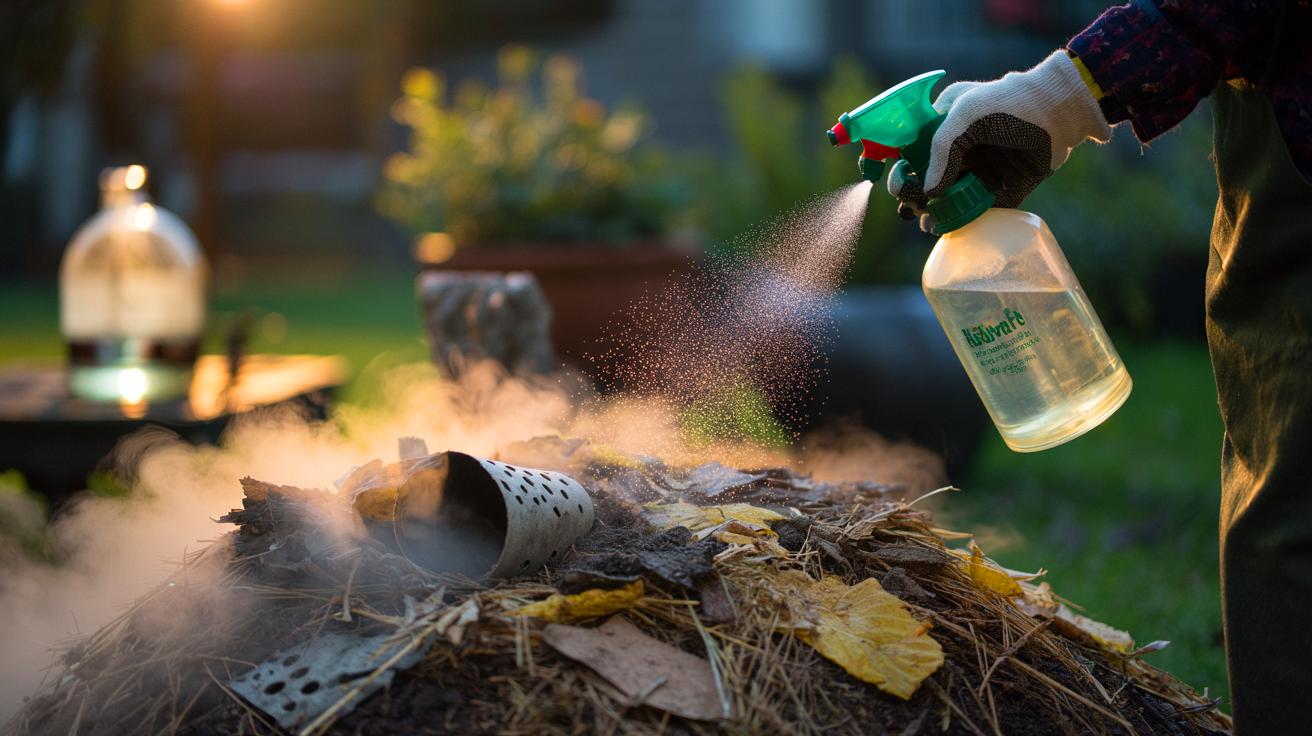
First, mix a gentle solution: 1 cup of standard 5% white vinegar in roughly 2 gallons (7.5 L) of water. That’s about 0.25% acetic acid—enough to shift surface pH without scorching the microbiome. Pre-turn the pile to break clumps and open channels. Pull aside any thick, slimy layers and blend them with shredded leaves or cardboard for immediate structure. Now mist the vinegar solution across the top 6–8 inches, just until evenly damp. Don’t drench. Follow with a 2–3 inch cap of dry browns to buffer acidity, trap odor, and attract air. Do not pour undiluted vinegar straight into the heap.
Insert a few coarse sticks or a perforated pipe to promote airflow, then check moisture—aim for a wrung-out sponge feel. Walk away and let chemistry and microbes collaborate. By morning, lift the cap and take a temperature reading; a 10–20°F rise signals renewed activity. If odors persist, repeat the light mist and add more browns. Resume normal feeding with a better green-to-brown balance. For worm bins, skip vinegar entirely—worms dislike acidity spikes. For very alkaline piles heavy in ash or lime, this method can be especially effective at quelling ammonia and restoring a friendlier pH band for decomposition.
Choosing the Right Vinegar and Dilution
Not all vinegars behave the same. You want predictable strength, neutral additives, and a clean finish. White distilled vinegar is the workhorse: plain, consistent, and inexpensive. Apple cider vinegar also works, though trace sugars may tempt pests if you overapply. “Cleaning” vinegars vary from 6% to 8% acetic acid; they’re stronger and demand tighter dilution. Skip balsamic and flavored varieties with sugars and syrups. When in doubt, err on the weaker side and rely on turning and browns to complete the reset.
| Vinegar | Acetic Acid % | Dilution per 2 gal Water | Best Use/Notes |
|---|---|---|---|
| White distilled | 5% | 1 cup | Neutral scent; reliable; ideal for most piles. |
| Apple cider | 5% | 1 cup | Works fine; avoid puddling to deter pests. |
| Cleaning vinegar | 6–8% | 3/4 cup (6%); 1/2 cup (8%) | Stronger; measure carefully to avoid over-acidifying. |
| Rice/malt (distilled) | 4% | 1 1/4 cups | Mild option; slightly more volume needed. |
Avoid industrial acetic acid or glacial solutions—overkill and risky. Watch for labels with added flavors or sugars. After any vinegar application, always cap with dry carbon and restore structure; that combination, not the acid alone, delivers the “overnight” effect.
Science Behind the Splash: pH, Odor, and Microbial Dynamics
Odor control begins with chemistry. Ammonia (NH3) stings the nose and escapes easily, but a slight pH drop converts it to ammonium (NH4+), which stays put, reducing volatilization. Vinegar’s acetic acid provides that temporary dip near the surface, while its conjugate base and carbon skeleton are metabolized by microbes once balance returns. The acid also helps dissolve carbonate crusts and mineral films that repel water, improving wettability so moisture penetrates evenly. This rapid shift turns a smelly, sealed crust into a breathable, microbe-friendly skin.
Microbiologically, a mild acid pulse prunes odor-causing anaerobes without scouring the entire ecosystem. Aerobes rebound quickly when oxygen and carbon are reintroduced. Keep the window narrow: compost thrives around pH 6–8. If you overshoot and drive pH too low, activity stalls. Use simple pH strips if you’re unsure, and rely on shredded leaves or straw to buffer swings. Think orchestration: a small acidity cue, a structural lift, a carbon blanket, and time. By morning, the microbial cast usually reshuffles in your favor, heat climbs, and the pile moves from stink to steam. Balanced inputs remain the long-term solution; vinegar is the catalyst, not the crutch.
A sluggish compost pile rarely needs heroics. It needs a nudge, structure, and balance. A measured vinegar mist can interrupt odors, re-wet crusts, and set the stage for vigorous, aerobic decay—fast. Pair that with a carbon cap and a thoughtful turn, and your heap often wakes up overnight. Keep notes on what you added, when you turned, and how the temperature responded; your pile will teach you. Ready to test the reset—and what tweaks will you try first to tailor it to your own mix and climate?
Did you like it?4.5/5 (23)