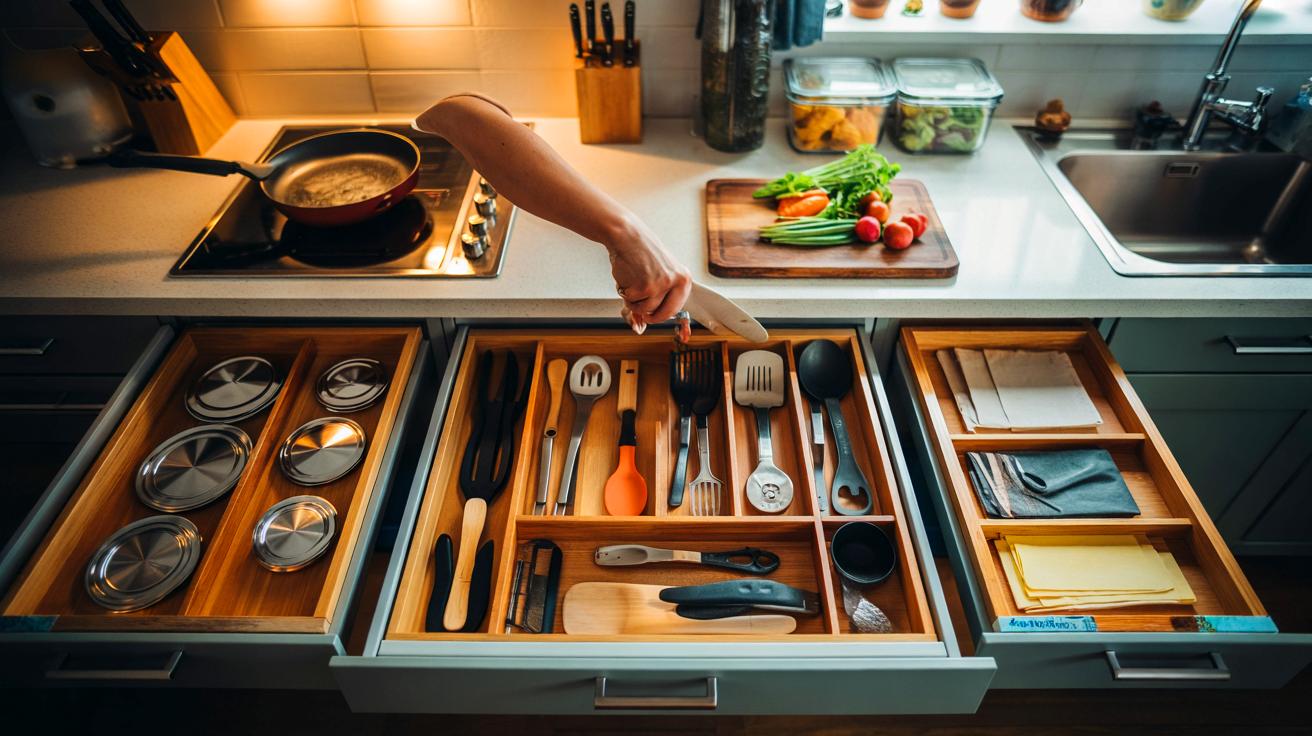
In a nutshell
- 🗺️ Map work zones (prep, cook, bake, store) and place tools by task and dominant hand to cut backtracking and speed up every move.
- 🧹 Purge and categorize ruthlessly: keep daily workhorses on top, use a 30-day “quarantine box,” and stop duplicates from piling up and wasting money.
- 🗂️ Optimize drawer interiors with adjustable dividers, anti-slip liners, shallow trays, and vertical lid files for instant visibility and grab-and-go access.
- 🏷️ Label and maintain: drawer-edge tags, monthly five-minute resets, seasonal rotations, and an outbox keep the system clear, shared, and durable.
- ⚡ Achieve faster cooking and less waste: quicker decisions, fewer lost tools, and easier leftover storage translate into daily minutes saved and fresh food preserved.
Every time you cook, your drawers either speed you up or slow you down. The difference isn’t luck. It’s layout. When utensils, lids, wraps, and gadgets live in predictable places, you chop faster, stir calmer, and clean with less friction. Think of drawer organization as a recipe for time savings. Start with zones, add tools, finish with labels. Small apartments benefit. Big family kitchens benefit more. The goal is simple: less hunting, fewer duplicate purchases, zero clutter choke points. With a plan you can sustain, your kitchen becomes a station for swift, low-waste cooking—and weeknight dinners stop feeling like a scramble.
Map Your Work Zones
The most efficient kitchens rely on work zones: prep, cook, bake, serve, and clean. Place drawers to match where tasks actually happen. If your cutting board lives next to the sink, your knives, peelers, and microfiber cloths should too. Let the workflow dictate the drawer, not the other way around. Imagine moving clockwise through a meal: wash, prep, cook, plate, store. Your drawers should follow that path like signposts. This simple mental map eliminates backtracking and reduces spills, especially when pans are hot and time is tight.
Turn the map into assignments. The drawer nearest the stove becomes the heat zone for spatulas, tongs, and thermometers. The one under the counter where you roll dough holds rolling pins, pastry brushes, and measuring cups. Keep kid utensils or lunch-prep items closer to the fridge. If you’re left-handed, mirror the layout to your natural reach. Anything used daily earns a top drawer; rare tools drop a level. You’ll feel the pace change immediately—fewer steps, faster hands, quieter nights.
| Zone | Drawer Contents | Why It Works |
|---|---|---|
| Prep | Knives, peelers, bench scraper, towels | Everything for chopping within one reach |
| Cook | Spatulas, tongs, ladle, thermometer | Hot pan tools parked by the stove |
| Bake | Measuring cups, scale, whisk, parchment | Precision gear grouped for consistent results |
| Serve/Store | Lids, wraps, reusable containers | Leftovers locked down fast to cut waste |
Purge, Then Categorize Ruthlessly
Speed starts with less. Pull every item out of your drawers. Sort into piles: daily workhorses, weekly specialists, and rare or redundant. If you can’t name a last use, it’s a candidate for donation. Broken peelers? Toss. Fifteen spatulas? Keep three. Reducing inventory is the most powerful step you can take to cook faster and waste less. With fewer tools, decisions shrink, and you stop buying duplicates because you couldn’t find the original under a tangle of gadgets.
Next, categorize by function, not by shape. Corkscrews belong with bottle stoppers, not “misc.” Bag clips live with wraps and foil, not snacks. Grouping by task sharpens muscle memory. It also exposes gaps—maybe you need a reliable can opener or a second measuring spoon set. Use a “quarantine box” for items you’re unsure about; store it for 30 days. If you never reach in, out it goes. Every item must justify its drawer rent by making a regular task quicker. That mindset keeps drawers lean long after the initial clean-out.
Design Drawer Interiors That Work
Drawer interiors need structure. Start with adjustable dividers or cut-to-size bamboo inserts to prevent tool drift. Add anti-slip liners so stacks stay put when drawers slide. For long utensils, try a diagonal configuration; it fits larger spatulas in standard drawers. Use shallow trays within deeper drawers to create layers—frequently used items up top, seasonal tools below. Design for visibility at a glance; if you can’t see it, you won’t use it. Clear bins are perfect for cookie cutters, piping tips, or tea accessories that otherwise scatter everywhere.
Lids are notorious time thieves. File them vertically using tension rods or a pot-lid rack inside a drawer near your cookware. Dedicate one narrow drawer to wraps—foil, parchment, beeswax—so sealing leftovers is frictionless and food lasts longer. Consider a compact knife dock if counter space is scarce; it keeps blades safe and reachable by the prep area. Measure before buying inserts; a 1/8-inch error can create rattling gaps. Label tray sections for quick reset after washing. When every item has a fitted parking spot, cleanup becomes automatic and fast.
Label, Maintain, and Adapt
Labels aren’t fussy; they’re tactical. Use simple drawer-edge labels or small waterproof tags on inserts: “Prep Tools,” “Spatulas,” “Wraps & Bags.” In shared homes, labels keep the system from unraveling. Add a discreet note inside the drawer front with a short list of its contents. That tiny roadmap guides guests and kids, and you stop playing scavenger hunt during dinner rush. Labeling protects your time investment and preserves your new speed. It also makes inventory checks painless, cutting impulse buys and reducing packaging waste.
Build a maintenance loop. Set a monthly five-minute reset: return strays, wipe liners, dump broken bands or stained spatulas. Keep a small “outbox” in a lower cabinet for items on trial; if they sit there untouched, donate. Seasonality matters, too—rotate grill tools up in summer and cookie cutters in December. Track frustration points: if you keep rummaging for a microplane, its spot is wrong. Change it. Great drawer systems evolve with your cooking life instead of freezing it in place. Adaptation keeps you fast today and faster next month.
Organized drawers don’t just look tidy. They compress decision time, prevent food spoilage by making storage supplies reachable, and nudge you to cook more often with less stress. Small upgrades—dividers, a lid file, clear labels—compound into daily minutes saved and fewer dollars wasted on duplicates or tossed leftovers. Try a single zone this weekend, feel the difference, then roll it across the kitchen in bursts you can sustain. Your future self will thank you every weeknight. Which drawer will you redesign first, and what will you move to make tonight’s dinner faster?
Did you like it?4.5/5 (26)
Mapping work zones by task and dominant hand finally clicked for me. I moved knives and towels next to the sink, spatulas by the stove, and cooking is smoother already. Thanks for breaking it down so clearly and practically.
My junk drawer achieved sentience years ago, but your quarentine box idea might finally evict it. Question: where do you stash weird one-offs like avocado slicers—prep or misc? Asking for a friend who owns, um, three. Oopsies.
Tried the vertical lid file and a dedicated wraps drawer tonight—leftovers were away in seconds 🙂 This is such a game-changer for weeknights. Any favorite brands for tension rods that don’t slip on slick liners?
Small galley kitchen, left-handed cook, and a toddler who raids drawers—how would you mirror zones and still keep sharp stuff safe? Thinking knife dock inside a top drawer, but worried about tiny fingers. Advise plesae?
Labeling the drawer edges was the breakthrough for my roommate circus. Now everyone returns tongs and peelers to the right spots, and our five-minute reset actually takes five minutes. Simple, visible, done. Thanks for the nudge!
Your diagonal utensil layout solved my monster spatula problem. I measured carefully but still left a pesky 3 milimeter gap; anti-slip liners fixed the rattle. Bonus: I can see whisks at a glance instead of digging.
Would you put the bake zone near the dishwasher or closer to the oven? I’m torn because measuring cups get washed daily, but I prep on a different counter. Curious how you’d prioritize the flow here.
That 30-day quarantine box is brilliant. I defintely kept two can openers because the first was hiding. Outbox + labels stopped the duplicate spiral and honestly saved grocery money too. Less rummaging means I actually cook on weeknights.
Your “map the meal clockwise” line clicked hard. I moved wraps next to storage containers and put the microplane where my hand naturally lands during prep. Now it’s speedrun dinners, fewer spills, and a calmer sink-to-stove shuffle.