In a nutshell
- 🥚 Eggshells are mostly calcium carbonate (94–97%), delivering slow-release calcium and a gentle liming effect in acidic soils thanks to their porous crystal-protein architecture.
- 🌱 They improve soil health by buffering pH, lowering aluminum stress, boosting aggregation and tilth, and providing grit that accelerates earthworm-driven decomposition.
- 🧪 Results hinge on prep: rinse, dry, bake, then grind to a fine powder; apply modestly to beds and containers, and pair with compost for faster, microbially active benefits.
- 🚫 Not a cure-all: minimal change in neutral/alkaline soils, “slug barriers” and “eggshell tea” are weak, and field-scale needs lime—so run a soil test and dose wisely.
- 🔬 Scientists note context rules—dissolution varies by particle size, moisture, and microbiome; shells can curb some metals—so use as a slow-release, low-waste calcium source within an integrated plan.
Gardeners have long sprinkled crushed eggshells around tomatoes and roses, but only recently have researchers mapped out the chemistry behind the habit. Turns out, eggshells are more than breakfast waste. They’re calcium-rich mineral packages with a porous lattice, slow to dissolve yet surprisingly active where soils run sour or depleted. When reduced to a fine grind, they can nudge pH, feed microbes, and strengthen plant tissues. In coarse form, they work differently—helping structure, offering grit to soil fauna, and moderating moisture at the root zone. The trick is understanding when the shells act fast, when they act slow, and how size, soil type, and climate change the outcome. Scientists are now unpacking those variables, and the story is both practical and hopeful.
The Science Inside an Eggshell
At its core, an eggshell is about 94–97% calcium carbonate (CaCO3), the same mineral family as limestone, with the remainder made up of magnesium, phosphorus, potassium, and an organic protein matrix. Under a microscope, its architecture looks like stacked crystals held together by a protein “glue.” That structure matters. It controls how moisture enters the shell and how quickly the carbonate dissolves. In acidic soils, dissolution happens faster, releasing calcium and neutralizing a share of free acidity. In neutral or alkaline soils, that process slows to a crawl, which is why results vary so widely across regions.
Unlike powdered agricultural lime, kitchen eggshells come in inconsistent particle sizes. Big fragments persist for months. Powders act far quicker. Researchers testing eggshell flour find a gentle but measurable liming effect and a steady stream of plant-available calcium as carbonic acid forms in the rhizosphere. The protein fraction plays a smaller yet notable role, feeding beneficial microbes that colonize the shell surface. Think of crushed eggshells as a slow-release mineral supplement with a built-in microbial landing pad.
How Eggshells Change Soil Chemistry and Structure
Calcium is a structural nutrient for plants, stabilizing cell walls and aiding root growth. In soils low in exchangeable calcium, eggshells can tip the balance. The carbonate anion also buffers acidity, which can reduce aluminum solubility, a quiet stressor for roots in strongly acidic beds. The net effect: less toxic ion activity, smoother nutrient uptake, and steadier growth. Soil physics benefits too. Calcium promotes aggregation, flocculating clays and improving tilth, aeration, and water infiltration. Earthworms use shell particles as grit, grinding organic matter more efficiently, which accelerates humus formation.
There’s a public-health angle: carbonate surfaces can bind certain heavy metals, lowering their plant availability in contaminated urban soils. The effect is context-dependent and not a cleanup license, but it’s real enough to be studied in remediation trials. That said, eggshells aren’t magic. Blossom-end rot in tomatoes, often blamed on “not enough calcium,” is frequently a water-transport problem, not a soil-calcium shortage. Still, raising baseline calcium can reduce the risk when moisture swings are controlled. Here’s a quick reference:
| Soil Condition | Eggshell Effect | Notes |
|---|---|---|
| Acidic (pH < 6) | Raises pH slowly; adds Ca | Faster if shells are finely ground |
| Clay-heavy | Improves aggregation | Pairs well with compost |
| Urban beds | May reduce metal bioavailability | Not a substitute for soil remediation |
| Neutral/alkaline | Minimal pH change | Use sparingly to avoid over-liming |
Practical Ways to Use Crushed Eggshells in Gardens
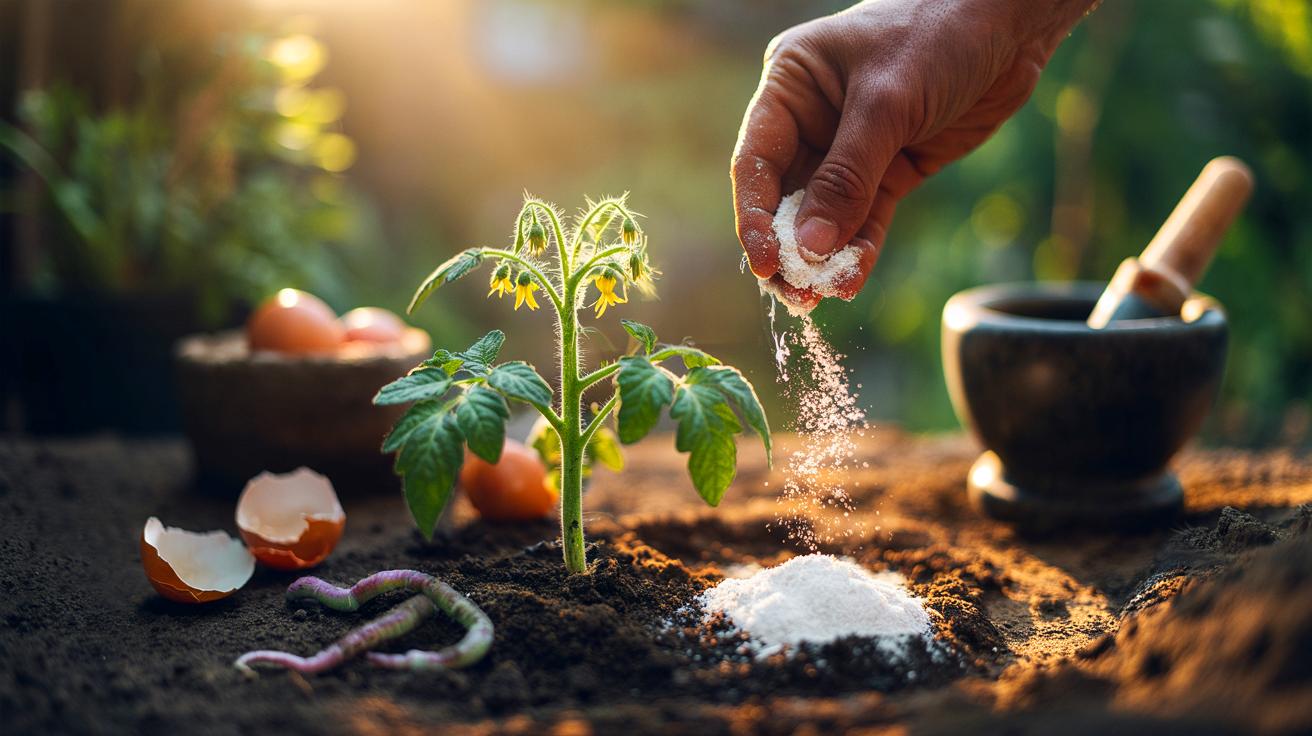
Preparation decides performance. Rinse shells, air-dry, then bake at low heat—about 95–120°C (200–250°F) for 10–20 minutes—to sanitize and make them brittle. Crush to a fine powder with a rolling pin or blender for the best chemistry. Powdered shells interact with soil far more rapidly than chunky shards. For beds, work in roughly 1–2 cups of powder per square yard (1–2 mm depth) ahead of planting, blending into the top 5–10 cm. For containers, mix a tablespoon per gallon of potting mix or scratch a teaspoon around established plants monthly during active growth.
Use them smartly. Combine with compost to create a calcium-rich, microbially active layer. Avoid heavy applications in already alkaline soils; a soil test is the cheapest insurance you can buy. Skip the myths: sharp shells are not reliable slug fences once they soften. “Eggshell tea” (soaking shells in water) extracts very little calcium unless acidified, so it’s more ritual than remedy. If you keep chickens, crushed shells can be sterilized and returned as calcium feed, but keep the garden portion separate and clean. A little, regularly, beats a single annual dump.
What Scientists Still Debate
The headline is clear—eggshells help—but the fine print is active research. Dissolution kinetics change with particle size, rainfall patterns, and the acids exuded by different root systems. Some studies report strong pH shifts in months; others see marginal change over a season because the shells weren’t finely milled. Microbiome effects also vary. The protein matrix may stimulate beneficial communities in one soil yet appear neutral in another, depending on existing organic matter and temperature. Context turns out to be everything.
There’s also the question of scale. Household shells can meaningfully amend raised beds and containers, but an acre of field soil demands agricultural lime for predictable outcomes. On pests, empirical trials show limited deterrence for slugs and snails once shells weather. And while eggshells can immobilize some metals, that benefit is not universal, nor permanent without complementary strategies. The consensus view: use crushed shells as a slow-release, low-waste calcium source within an integrated management plan—compost, mulches, irrigation discipline, and timely soil testing.
Crushed eggshells turn a kitchen castoff into measurable soil capital: a gentle liming agent, a calcium reservoir, and a texture tweak that supports roots and microbes. They’re not a cure-all, yet they steadily improve conditions where acidity, compaction, or calcium scarcity hold plants back. The payoff grows with preparation, particle size, and thoughtful pairing with organic matter. So save the shells, bake, grind, and scratch them in where they’ll matter most, then watch your soil respond across the season. Where in your garden would a slow, steady drip of calcium and buffering power make the biggest difference this year?
Did you like it?4.6/5 (25)