In a nutshell
- 🧠 Handwriting engages sensorimotor encoding and creates spatial anchors, producing stronger memory through context-rich cues.
- 📝 Beyond cognitive offloading, handwritten lists leverage the generation effect, reduce intrusions via the Zeigarnik effect, and operationalize goals with implementation intentions.
- 🔬 Research shows longhand fosters deeper processing with better delayed recall and prospective memory, while fast digital entry risks shallow engagement.
- ✅ Build memory-friendly lists: limit to about seven items to respect working memory, lead with action verbs, position priorities top-left, use distinct symbols, and rehearse for spaced repetition.
- 📱 Go hybrid: write to remember, then digitize to coordinate—paper strengthens encoding and prioritization; apps add collaboration and reminders.
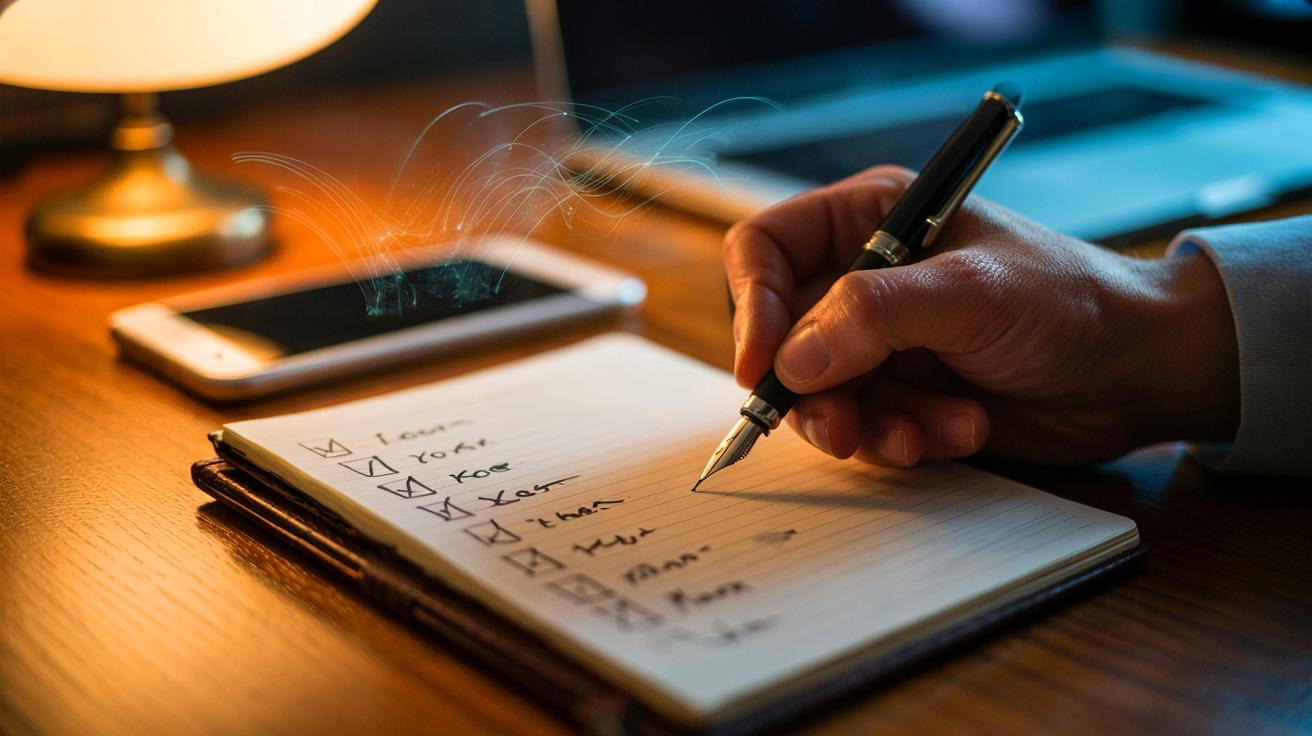
Every day begins with a choice: trust your phone to remember, or trust your pen. Researchers say the latter wins more often than you think. Writing a to-do list by hand does more than capture tasks. It imprints them. As the nib scratches paper, your brain lights up across regions tied to movement, attention, and memory. That multisensory burst gives handwritten lists an edge. Digital tools are fast. They’re searchable. Yet speed can be shallow, encouraging skimming rather than encoding. Handwriting slows you just enough to think, prioritize, and connect. The result is a plan you can recall later, even without the page.
The Brain Loves Ink: Sensorimotor Encoding and Spatial Cues
Handwriting recruits a network that typing often leaves idle. As you shape letters and symbols, the brain integrates motor, visual, and auditory signals into a single memory trace. The effect is sometimes described as sensorimotor encoding. The more channels engaged during learning, the more robust the recall. The act of forming each stroke also produces micro-pauses that prompt evaluation—What comes first? What matters most?—which deepens processing. Researchers using EEG and fMRI have found richer patterns of activation during longhand writing than during tapping or swiping, especially in areas involved in attention and memory integration.
Paper adds something screens rarely do: spatial anchors. Tasks live at the top margin, in the lower left corner, beside a doodle. These landmarks become cues. Later, you may not remember the entire list, but you might recall that “call the contractor” sat mid-page with a star. That’s spatial memory at work, aided by encoding specificity—we retrieve information best when the context at recall resembles the context at learning. A physical page provides a stable, persistent context that your brain can map. The result is not just familiarity, but stronger, more accessible memory.
From Offloading to Remembering: The Psychology Behind Lists
To-do lists are often framed as cognitive offloading—freeing working memory by placing intentions outside the mind. That’s true, and useful. But offloading is only half the story. The moment you pick up a pen, you trigger the generation effect: people remember information better when they produce it themselves. Composing a verb, choosing a verb tense, even drawing a checkbox—all of it strengthens encoding. Writing turns a vague intention into a concrete, self-generated cue, which sticks longer than a tap on a template.
Handwritten lists also exploit two classic phenomena. First, the Zeigarnik effect: the mind keeps unfinished goals active. Writing them down reduces intrusive thoughts by assuring the brain a plan exists, which eases anxiety without erasing motivation. Second, implementation intentions—the “if-then” format—transform goals into triggers. “If it’s 3 p.m., then send the draft.” On paper, these cues sit visible and tactile, inviting rehearsal. Each reread becomes spaced repetition in miniature. Over time, this cycle—generate, externalize, rehearse—builds recall and follow-through, not just organization.
Paper Versus Apps: What Experiments Reveal
Across laboratories, a pattern emerges. Studies comparing longhand to typing show that manual note-takers and list writers engage in deeper processing, paraphrasing and prioritizing rather than transcribing. Research teams using neural measures report more synchronized activity tied to memory formation during handwriting. In behavioral tasks, people who draft plans by hand often show better delayed recall and more accurate follow-through on prospective memory tasks—remembering to do something at the right time. When the goal is to remember, friction helps. Apps reduce friction. Paper harnesses it.
That doesn’t mean screens fail. Digital lists excel at collaboration, reminders, and search—features paper can’t match. Still, speed can tempt us into shallow engagement. Autocomplete suggests your priorities. Checkboxes appear before you think. Handwriting forces selection. The item you choose to write is the item you choose to remember. To clarify how methods differ, here is a concise overview:
| Method | Primary Benefit | Typical Pitfall | Best Use |
|---|---|---|---|
| Handwritten list | Deeper encoding via sensorimotor and spatial cues | Harder to search; no automatic reminders | Planning, prioritization, long-term recall |
| Typed list | Speed, searchability, cloud sync | Shallow processing; over-collection | Teamwork, reference archives, rapid capture |
| Hybrid (paper + app) | Strong encoding with digital backup | Duplication overhead | Critical tasks with reminders and review |
How to Build a Memory-Friendly To-Do List
Design your list to match how memory works. Start by writing no more than seven items per section to respect the limits of working memory. Use verbs first: “Email Maria,” “Draft budget,” “Book lab.” Action-forward phrasing increases recall and reduces procrastination. Place the most important task at the top-left—your natural attentional hotspot on a page in English. Leave white space. It becomes a visual cue and a reward pathway as the list evolves during the day.
Turn intentions into cues. For time-sensitive tasks, write simple implementation intentions: “If it’s 10:00, call the clinic.” For location-based tasks, add a contextual tag: “At desk—submit expense report.” Consider quick sketches or symbols; a small phone icon or star creates distinctiveness, boosting memory through the brain’s preference for novelty. Distinctive items are easier to find later, both on paper and in mind. Finally, rehearse. Read your list aloud once mid-morning and once mid-afternoon. Those 20-second check-ins create spaced repetition without feeling like study.
Handwritten to-do lists thrive because they slow us down just enough to think, converting noise into priorities and intentions into cues. The pen’s friction is not a bug; it’s the feature that deepens encoding and makes recall reliable when the day gets loud. Apps still belong in the toolkit, especially for collaboration and reminders, but they shine brightest when paired with paper. Write to remember, then digitize to coordinate. That blend respects how the brain learns and how modern work flows. If your goal is sharper memory and steadier follow-through, what will your next handwritten list look like—and when will you put it on paper?
Did you like it?4.6/5 (20)